Artificial olive trees in corporate spaces
Artificial olive trees allow you to reinforce your corporate image without maintenance. They work well in offices, hotels, and stores
Artificial olive trees allow you to reinforce your corporate image without maintenance. They work well in offices, hotels, and stores because they provide natural aesthetics, visual consistency, and well-being. They are a cost-effective and stable solution for any business that wants a professional, well-maintained, and consistent environment.
In today’s business world, the image of a space can be as influential as the quality of the service it offers. A well-maintained environment conveys professionalism, trust, and consistency. In this context, artificial olive trees are an elegant and functional solution for improving corporate aesthetics, reinforcing brand identity, and creating healthy environments consistent with the latest trends in workplace well-being.
More than just a decorative element, artificial olive trees have become a strategic interior design tool that combines natural beauty, durability, and low maintenance. This makes them ideal for modern offices, restaurants, hotels, clinics, or stores that want to enjoy the green presence of olive trees without the care required for natural plants.

The decoration of a business space not only serves an aesthetic purpose: it communicates values and emotions. A well-placed decorative olive tree can convey serenity, stability, and sophistication, qualities that every brand wants to project.
Decorative olive trees are highly prized for their Mediterranean symbolism, associated with prosperity and peace. In offices and hotels, they bring a touch of calm; in restaurants or shops, they create a welcoming and authentic atmosphere.
The use of large artificial olive trees or mini olive trees allows the scale to be adapted to each space. From a small olive tree on a table to an artificial olive tree presiding over the reception area, they all serve the same purpose: to create visual harmony and brand consistency.
In addition, realistic artificial olive trees maintain their perfect appearance over time, ensuring that the customer’s first impression is always positive.
A realistic artificial olive tree is a high-quality replica of the classic Mediterranean olive tree, made from durable materials such as polyester, silk, or resin. Its design reproduces the leaves, natural wood trunk, and texture of the original tree in detail, achieving a natural and long-lasting appearance.
In business environments, an artificial olive tree or a mini indoor olive tree offers the perfect balance between aesthetics and functionality. Olive trees require minimal care, do not generate waste or pollen, and retain their intense green color regardless of light or climate.
Artificial trees, such as large or small olive trees, are ideal for reception areas or large spaces, while small olive trees decorate desks, counters, or meeting rooms with a natural touch of green.
Thanks to their realism and versatility, artificial olive trees can be easily integrated into any type of design, whether minimalist, classic, or Mediterranean, always bringing freshness and a visual effect of nature to indoor or outdoor spaces.
In the business environment, efficiency is key. An artificial olive tree eliminates the inconveniences of maintenance without sacrificing aesthetics. Compared to natural olive trees, these large artificial trees that look like real olive trees offer significant practical and economic advantages:
Key benefits for businesses:
Both a mini indoor olive tree and a large decorative olive tree maintain the same appearance regardless of the season. This natural, evergreen look allows businesses to always maintain a well-groomed image, which is essential in professional environments.
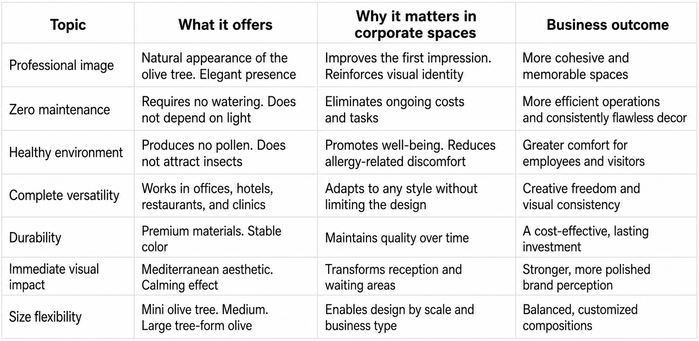
One of the main advantages of realistic artificial olive trees is that they are available in several sizes and styles, allowing the decoration to be customized according to the type of space and brand identity.
Most commonly used types in companies and businesses:
Large artificial olive trees add presence and elegance, while small or mini olive trees convey warmth and detail. Combining different sizes creates a balanced visual effect that brings freshness and reinforces the identity of the business.
From a mini olive tree on your desk to a large artificial olive tree in your entrance hall: every detail contributes to your brand’s visual identity.
For example, an artificial olive tree in a hotel lobby conveys exclusivity, while a mini indoor olive tree in a boardroom brings serenity and professionalism.
In offices, stores, and commercial spaces, artificial olive trees have become key decorative elements in interior design. Their function goes beyond aesthetics: they help structure spaces and improve the customer experience.
Common applications:
The possibility of combining small olive trees with large artificial olive trees offers flexibility to play with scale and composition. Some businesses even use them as natural dividers or corporate scenery, integrating them into their visual identity.
Including artificial olive trees in interior design not only beautifies the space, it also improves the psychological well-being of those who work or visit the place.
Green tones and organic shapes create calm, reduce visual stress, and promote concentration.
A realistic artificial olive tree brings that feeling of living nature without the drawbacks of a natural plant. Plus, being hypoallergenic and maintenance-free, it contributes to a healthy environment without the need for extra care.
In modern offices, a mini indoor olive tree on each desk can make the difference between a neutral environment and an inspiring one. In a hotel or restaurant, a large decorative olive tree can convey the Mediterranean warmth that customers associate with comfort and well-being.
Artificial olive trees offer an advantage that few natural plants can match: total mobility.
An artificial olive tree can be easily moved from one event to another, or from the reception area to a meeting room, without worrying about watering or lighting.
This flexibility allows companies to effortlessly update the image of the space. Large artificial olive trees can be reused at trade shows, presentations, or inaugurations, where they will provide aesthetic consistency and a natural look in all contexts.
Mini olive trees and artificial olive trees are also very versatile: they can be used for temporary campaigns or integrated into seasonal decorations without deteriorating. This allows every business to maintain a lively and changing aesthetic without additional costs.
The artificial olive tree has gone from being a decorative element to becoming a strategic tool for companies seeking a balance between aesthetics, functionality, and efficiency.
Their versatility, realism, and low maintenance make them a profitable and long-lasting investment. From a mini olive tree in an office to an artificial olive tree at the entrance of a hotel, these elements convey professionalism, naturalness, and harmony. That is why the sale of artificial olive trees for corporate spaces and businesses continues to boom.
Large decorative olive trees project a solid image, while small olive trees add warmth and detail. Together, they form a visual language consistent with the values of a modern brand: careful, sustainable, and with a long-term vision.
In short, choosing a realistic artificial olive tree for business environments is much more than an aesthetic decision: it is a smart strategy for conveying well-being, style, and visual consistency in any business.
Artificial olive trees allow you to reinforce your corporate image without maintenance. They work well in offices, hotels, and stores
This year marks a turning point in interior design. Nature, reinterpreted through design, is establishing itself as the dominant visual
In the business world, decoration has gone from being an aesthetic detail to a strategic tool. Today, buying artificial plants
For years, artificial plants were seen as mere decorative accessories. Today, however, they occupy a central place in contemporary interior
Interior design and commercial architecture are undergoing a profound transformation. More and more companies are incorporating vegetation as part of
Contemporary interior design seeks to strike a balance between aesthetics, functionality, and well-being. In this context, large and small artificial
The charm of artificial plants in home décor Artificial plants have gained popularity in interior design due to their combination
In today’s world, where sustainability and environmental responsibility are increasingly important, the decoration of commercial spaces has also evolved. Artificial

Creating a stimulating work environment Workspace design plays a crucial role in productivity and creativity. Artificial plants have become a

Home décor has entered a new era with the arrival of artificial plants that combine beauty, realism, and practicality. These