Artificial olive trees in corporate spaces
Artificial olive trees allow you to reinforce your corporate image without maintenance. They work well in offices, hotels, and stores

Content reviewed and updated on 4 August 2026.
Choosing large artificial palm trees for a professional project means considering the complete silhouette: vertical development, crown spread and relationship with the surrounding volume. A large artificial palm tree should be assessed using its dimensions, viewing distance and exact placement.
For hospitality, retail, shopping centres and communal areas, first define the palm’s function and its relationship with the architecture, circulation routes and nearby elements.
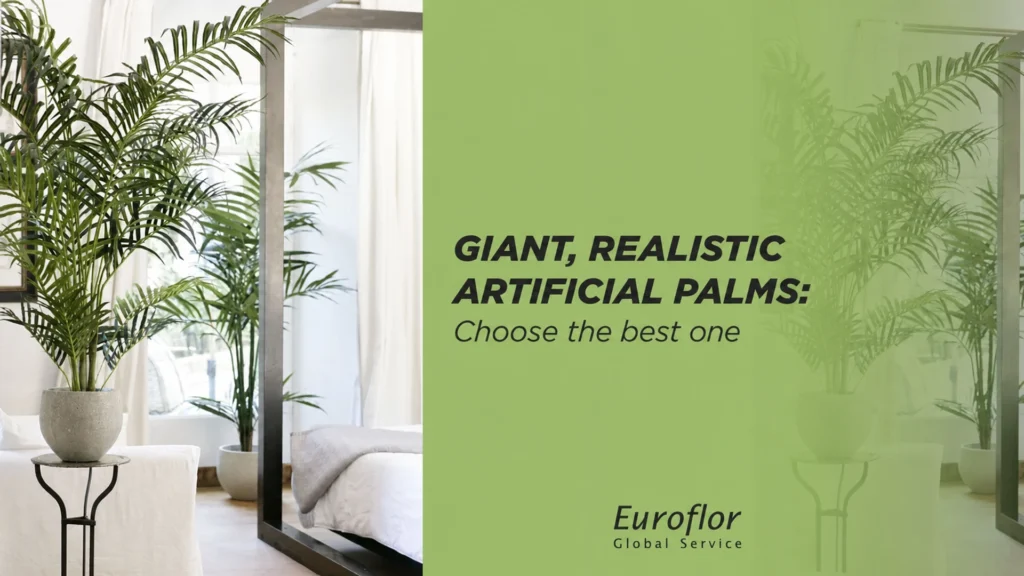
A palm can act as a visual reference, accompany a meeting area, give rhythm to a route or connect different heights. Before choosing a family, define whether it will be a focal piece or part of a group, where it will be viewed from and the function it will serve in the lobby, restaurant or commercial area.
Total height is only one part of the decision. Check the relationship between the trunk and crown, the available width and depth, clearance from ceilings or lighting, and the viewing distance. A piece that appears well proportioned in a photograph may read differently beside a counter or circulation area.
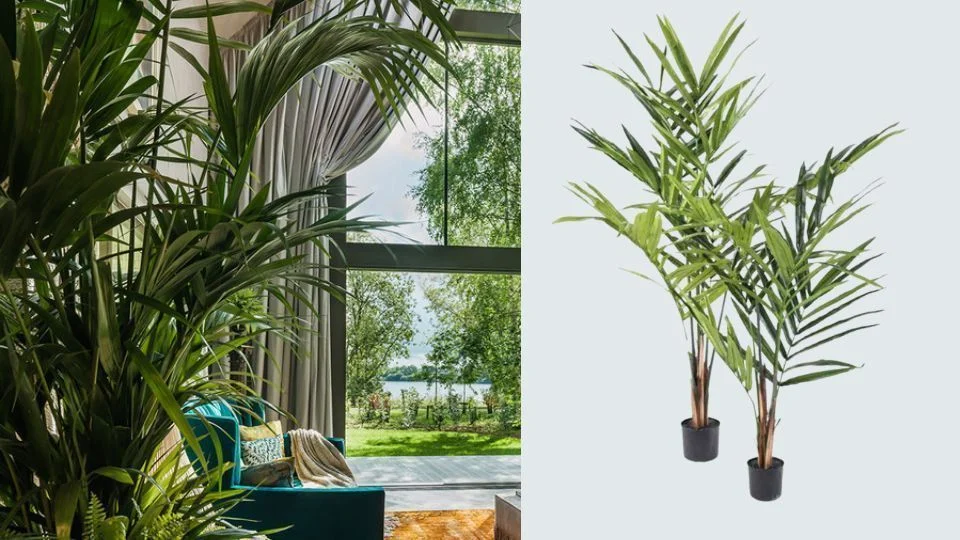
The current professional catalogue includes Phoenix, Areca and Kentia, among other names. The table helps compare the visual presence of each option without turning its name into an automatic recommendation.
| Type | What to examine in the option | What to check in the space |
|---|---|---|
| Phoenix | Crown spread and width, the relationship between trunk and crown, and the height at which the crown begins. | Clear height, maximum width, clearance around the crown and principal viewpoints. |
| Areca | Number and spacing of trunks, volume from the base and the visual density of the foliage. | Width and depth through the lower and middle zones, circulation and nearby furniture. |
| Kentia | Leaf spread, visual density and the overall width of the composition. | Available height, width and depth, circulation routes, shop windows and signage. |
The table is an initial filter. Dimensions, the base, access, whether the area is indoors, covered or outdoors, and any technical performance requirements must be confirmed for the selected option.
If the tree type has not yet been decided, the guide to choosing a large artificial tree provides a general method for comparing large-format options.
In a hotel, the composition must respect circulation, sightlines and how the area is used. In retail, check that the crown does not interfere with products, shop windows or signage. In shopping centres and communal areas, also consider views from several levels and over long distances.
The fact that a search mentions outdoor use does not mean that every artificial palm is suitable for outdoor conditions. First define whether it will be indoors, in a covered area or exposed to outdoor conditions, and then check the documentation that applies to the specific product.
Characteristics such as UV performance, fire resistance, materials or fixing requirements must not be generalised across the entire family. They should only be added to the specification when they are documented for the option being considered.
The base, planter and their junction with the floor form part of the result. Confirm their dimensions and check the route through doors, corridors or lifts. Any installation or fixing requirements must be resolved using verifiable information.
Provide the type of space, the palm’s function, its exact placement, whether it will be indoors, in a covered area or outdoors, the available dimensions, viewing points, access routes and any technical requirements that must be documented. This framework makes it possible to compare families and silhouettes using specific questions.
It depends on the clear height, crown width, viewing distance and nearby elements. The proportion of the whole composition matters more than an isolated measurement.
Only when the product documentation confirms that it is suitable for outdoor use under the intended conditions. This must not be assumed for the entire range.
The current catalogue includes Phoenix, Areca and Kentia palms, among others. The details of each option should be checked when making the selection.
Provide the project type, exact placement, whether the area is indoors, covered or outdoors, available dimensions, use of the area, viewing points, access routes and any requirements that need supporting documentation.
The right palm is the one that responds to the scale, exact placement, indoor, covered or outdoor conditions, and the composition. Use those details as a filter before reviewing the catalogue.
Artificial olive trees allow you to reinforce your corporate image without maintenance. They work well in offices, hotels, and stores
This year marks a turning point in interior design. Nature, reinterpreted through design, is establishing itself as the dominant visual
In the business world, decoration has gone from being an aesthetic detail to a strategic tool. Today, buying artificial plants
For years, artificial plants were seen as mere decorative accessories. Today, however, they occupy a central place in contemporary interior
Interior design and commercial architecture are undergoing a profound transformation. More and more companies are incorporating vegetation as part of
Contemporary interior design seeks to strike a balance between aesthetics, functionality, and well-being. In this context, large and small artificial
The charm of artificial plants in home décor Artificial plants have gained popularity in interior design due to their combination
In today’s world, where sustainability and environmental responsibility are increasingly important, the decoration of commercial spaces has also evolved. Artificial

Creating a stimulating work environment Workspace design plays a crucial role in productivity and creativity. Artificial plants have become a

Home décor has entered a new era with the arrival of artificial plants that combine beauty, realism, and practicality. These